
The Sentinel Briefing: June 2025
June 94 2025
The Invisible Web: How Seven Powers Just Rewired Global Commerce`
A Strategic Intelligence Brief for Investors & C-Suite Leaders
The Signal Hidden in Plain Sight
On May 23, 2025, at 4:47 PM Eastern, the U.S. Treasury issued General License 25, a seemingly routine document lifting sanctions on Syria (U.S. Treasury OFAC, May 23, 2025). Most markets barely noticed. But the license's exclusions reveal strategic intent: GL 25 explicitly prohibits transactions benefiting Russia, Iran, and North Korea - Assad's former backers - while maintaining broader OFAC compliance requirements. This creates a regulatory environment where parties engaging in Syrian reconstruction may voluntarily adopt U.S.-aligned legal and financial frameworks to mitigate compliance risks, though the license itself imposes no such mandates.
This was a masterclass in invisible empire-building.
The same day, 3,000 miles away, European officials quietly announced €300 million in green transition funding for the Middle East while doubling down on their two-state solution strategy (European Commission, May 23, 2025). Two weeks later, Xi Jinping landed in Moscow to finalize the $245 billion China-Russia trade framework, formalizing the emerging Russia-China-Iran triangle (Financial Times, June 8, 2025). In Riyadh, Crown Prince Mohammed bin Salman was orchestrating $770 billion in U.S. investments while simultaneously deepening OPEC+ coordination with Putin (Saudi Public Investment Fund, May 2025). In Doha, Qatar signed a €2 billion joint investment fund with Russia while pledging $1.2 trillion in U.S. infrastructure partnerships (Qatar Economic Review, Q2 2025).
While markets treated these as separate stories, they were moves in the same global chess game: a race to control the infrastructure that makes modern commerce possible. But this wasn't just America, Europe, and China competing.
Seven powers were simultaneously building competing, and sometimes overlapping, operating systems for the global economy, each with built-in redundancies against disruption.
The Great Rewiring: Seven Players, Multiple Games
America’s Play: The Invisible Empire
Behind closed doors, a select group of U.S. power brokers has begun orchestrating a new model for influence in the Middle East. Jared Kushner’s Affinity Partners, backed by nearly $5 billion in Gulf capital, is a leading example - acting as a cross-border bridge for sovereign investment. While Steve Witkoff has handled diplomatic engagement as the U.S. special envoy to the region, and Thomas Barrack, now the official U.S. envoy on Syria, has leveraged his real estate and financing networks to position American and Gulf capital at the forefront of reconstruction planning.
The Execution
By mid–2025, U.S. and Gulf negotiations have produced a new diplomatic package: sanctions on Syria are being eased, with the U.S. Treasury issuing licenses and compliance protocols that require most significant reconstruction and infrastructure deals to flow through financial structures subject to American oversight. This ensures transparency and traceability, particularly in high-value transactions.Meanwhile, the Trump administration has selectively relaxed export controls on advanced AI hardware, greenlighting multi-billion-dollar infrastructure projects in Saudi Arabia and the UAE. These agreements anchor the technology supply chain within U.S. or allied infrastructure to manage strategic risk and restrict diversion.In parallel, commodity regulatory collaboration is tightening. There’s no sweeping mandate for blockchain settlement of gold trades yet, but select pilot programs are routing major transactions via digital ledger systems co-developed with Western partners. These systems are designed to enhance transparency and enable real-time auditability when required, marking a shift in how value and compliance are managed in the region.
The Numbers
U.S.–Saudi financial integration is reaching new peaks. Saudi Arabia has set out an investment corridor with up to $600 billion in prospective commitments across multiple years: over $300 billion in deals and memoranda have been announced in 2025 alone, and while the realized flow is smaller, the momentum is clear with Saudi involvement in U.S. equities and assets at all-time highs.American tech partnerships with Gulf states in AI and digital infrastructure now total more than $10 billion in announced joint ventures, including data centers, chip foundries, and cloud computing platforms, each underpinned by U.S. technology supply agreements.In Syria, U.S. and Gulf officials are discussing reconstruction initiatives that could exceed $200 billion over the coming decade. These are working targets and policy ambitions rather than executed contracts, but recent U.S. licensing steps show a clear intent: any major rebuild will happen within legal and financial channels aligned with U.S. and Western standards.
Europe's Counter: The Green Corridor with Political Conditions
While America embedded itself in digital infrastructure, Europe pursued a different game: reshaping physical trade routes while advancing political solutions. The EU's €300 million green transition initiative wasn't just about sustainability. It was about positioning Europe as the essential partner for Middle Eastern energy diversification while pushing its two-state solution agenda.The Crown Jewel: The India-Middle East-Europe Economic Corridor (IMEC), a $20 billion infrastructure project connecting India to Europe via UAE, Saudi Arabia, and Mediterranean ports (European Commission, April 2025). But IMEC's success hinges on regional stability, particularly in Israel and Palestine, making the EU's diplomatic strategy as critical as its infrastructure investment.The Political Gamble: Europe's doubling down on Palestinian Authority support and two-state solutions may create friction with U.S. and Gulf priorities, especially if Arab-Israeli normalization efforts stall amid ongoing conflict.
China's Response: The Eastern Triangle
Xi Jinping's May 2025 visit to Russia was economic architecture. The "no limits" partnership crystallized into the increasingly formalized Russia-China-Iran triangle: $245 billion in bilateral China-Russia trade, joint energy projects like the Power of Siberia 2 pipeline, and critically, yuan-based payment alternatives designed to bypass Western financial controls entirely.The Strategic Logic: While America and Europe competed for Middle Eastern integration, China was building a complete parallel economic universe with $39 billion in regional BRI investments, alternative payment systems, and joint infrastructure projects specifically designed to operate outside Western oversight (Chinese Ministry of Commerce, March 2025).
Saudi Arabia: The Ultimate Diplomatic Broker
Crown Prince Mohammed bin Salman is executing perhaps the most sophisticated "multi-alignment" strategy in modern history. With non-oil GDP now at 52% through Vision 2030, Saudi Arabia has transformed from energy exporter to global infrastructure broker and diplomatic mediator.The Numbers Game: $770 billion in U.S. assets, $600 billion in new American investments, yet deepening OPEC+ coordination with Russia and $19 billion in Chinese BRI deals. The Kingdom's $700+ billion Public Investment Fund isn't just investing, it's creating dependencies across all major power centers.Diplomatic Innovation: Saudi Arabia now mediates Ukraine talks, hosts summits with all major powers, and positions itself as the indispensable partner for global climate and AI infrastructure. They're not choosing sides, they're making every side need them while building redundancy against any single system failure.
Qatar: The Energy Arbitrageur and Regional Mediator
Qatar has perfected the art of strategic hedging, leveraging its energy dominance for unprecedented diplomatic access. The tiny emirate simultaneously signed a $1.2 trillion infrastructure pact with the U.S. while launching a €2 billion joint investment fund with Russia.Energy Diplomacy: Aiming to boost LNG output by 40% and become a leader in green and blue hydrogen, Qatar is making itself indispensable to both Western energy security and Eastern development needs while building multiple supply route redundancies (Qatar Economic Review, Q2 2025).The Mediation Premium: From U.S.-Iran talks to Israel-Hamas negotiations, Qatar's diplomatic agility creates value beyond its energy resources. Every crisis becomes a business opportunity, every conflict becomes a mediation contract.
India: The Corridor Kingmaker with Asian Ambitions
India has emerged as the critical link in reshaping global trade architecture. The IMEC corridor positions India not just as a destination but as the essential connection between Asian production and European consumption, while building resilience against Chinese trade route dominance.Strategic Calculus: The $9 billion Vadhavan Port and IMEC infrastructure partnerships with Gulf states and Israel create alternatives to Chinese-controlled trade routes while deepening security cooperation (Indian Ministry of Commerce, May 2025). India is building itself into the new Silk Road with built-in redundancies.Trilateral Innovation: India-Israel-Gulf cooperation creates new models for technology, security, and trade partnerships that bypass traditional power centers while hedging against corridor disruption.
Russia: The Sanctions-Resistant Alternative Builder
Putin's strategy extends far beyond the war in Ukraine. Russia is actively constructing parallel systems to Western infrastructure, with energy and payment rails as the foundation of a sanctions-proof architecture.The Eastern Triangle: The Russia-China-Iran alliance isn't just geopolitical, it's architectural. Yuan-based oil sales, alternative payment systems, the International North-South Transport Corridor linking Russia-Iran-India, and joint energy projects create completely independent infrastructure designed to operate regardless of Western sanctions.Arab Outreach: The 2025 Russia-Arab Summit wasn't about diplomacy—it was about offering Gulf states alternatives to Western systems (Russian Economic Forum, May 2025). OPEC+ coordination with Saudi Arabia gives Russia influence over global energy flows despite sanctions, while the €2 billion Qatar investment pact demonstrates Gulf willingness to build multiple system redundancies.
The Critical Disruptors: Iran and Israel
Iran: The Alternative Corridor Integrator
Iran has transformed isolation into innovation, building infrastructure that operates entirely outside Western systems. The $20 billion high-speed rail network and integration into alternative trade corridors like the International North-South Transport Corridor make Iran a critical node in sanctions-resistant infrastructure.Triangle Architecture: The hardened Iran-Russia-China alliance provides economic, military, and diplomatic insulation while creating alternative systems for any economy seeking to operate outside Western control, a model increasingly attractive as sanctions proliferate.
Israel: The Volatile Essential Node
Despite ongoing military operations in Gaza and the largest West Bank settlement expansion in decades, Israel finds itself essential to new trade architecture. The $50 billion Gush Dan infrastructure expansion and Haifa port's role in IMEC make Israel a critical but unstable link in European-Asian trade routes.The Volatility Premium: Israel's ongoing conflicts and settlement policies create major sources of regional instability that could disrupt corridor security and investment flows. IMEC's success requires Israeli stability that current policies may undermine.
Seven Operating Systems: A Condensed Map of Strategic Control
As global powers compete across diplomatic stages, what matters more is what’s embedded, into contracts, corridors, code, and compliance systems.
See the condensed map of strategic control here
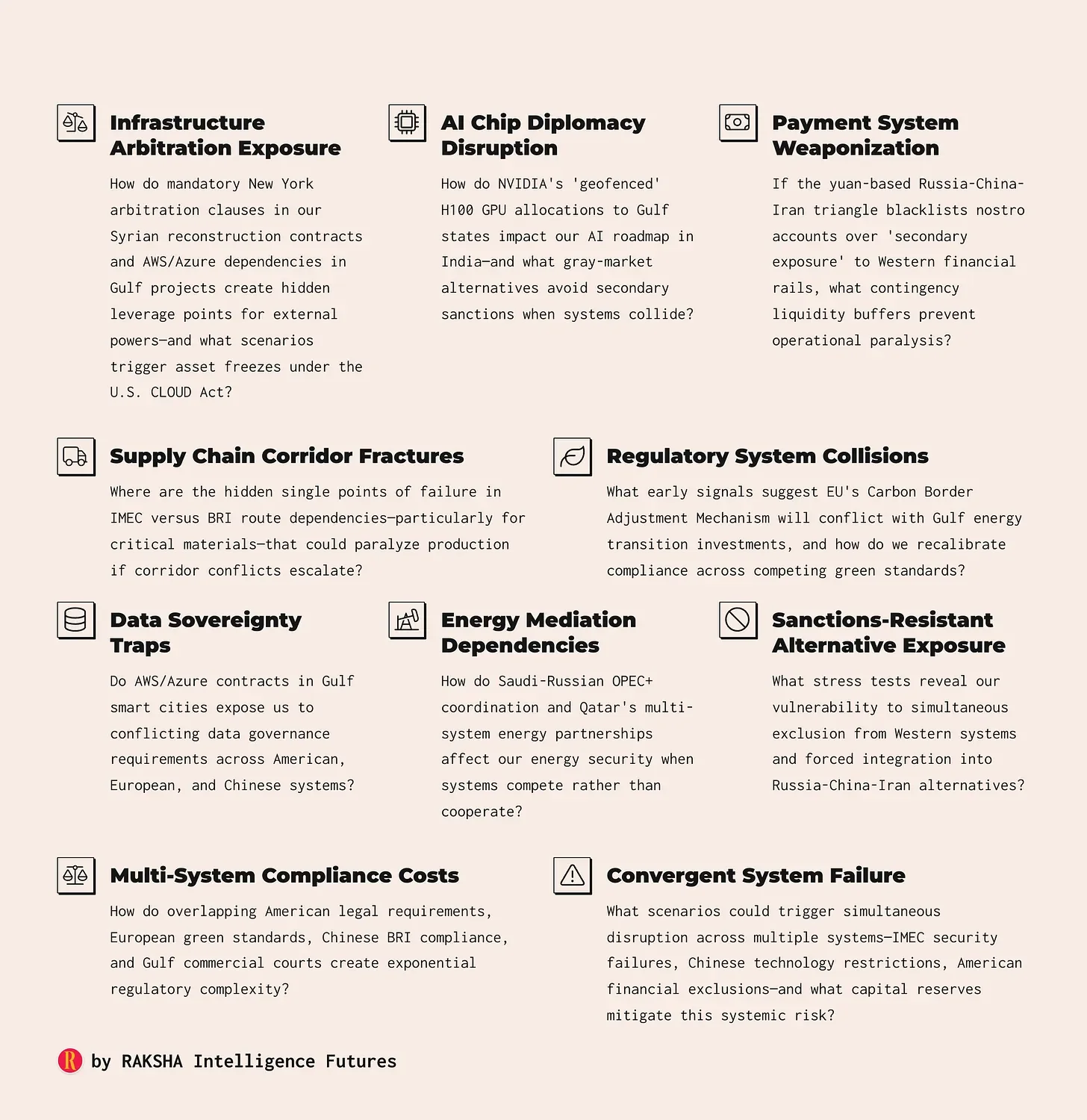
The Questions Smart Leaders Are Already Asking
These aren't theoretical risks or academic exercises. They're the operational questions keeping sophisticated executives awake at night—the ones who've already recognized that traditional risk frameworks can't capture seven-system complexity.
The smartest leaders we work with aren't waiting for geopolitical events to clarify. They're asking granular, operational questions about dependencies they can see building but can't yet quantify. What we do is help structure these instincts into actionable intelligence, stress-test the scenarios, and map the cascade effects across legal, digital, financial, and physical infrastructure.
Here's what those questions look like in practice:
What This Means for Leadership
For Investors: The companies asking these questions aren't just managing risk—they're building competitive moats. Portfolio evaluation now requires assessing multi-system resilience, not just market position. The firms that can operate when systems fracture will capture value when others can't.
For C-Suite Leaders: These questions define the new operational baseline. The executives answering them first are building the institutional knowledge and contingency capabilities that will matter most when infrastructure becomes contested terrain.
For Board Members: Governance in the seven-system world requires new oversight capabilities. Board agendas must include system dependency reviews, cascade scenario planning, and cross-jurisdictional risk assessment—not just traditional market and operational updates.Smart leaders are already asking these questions.
RAKSHA's role is to make sure the answers come before the exposure does.
The executives we work with understand that operating across fractured systems requires intelligence that sees intersections, not just individual risks. They need operational clarity on dependencies they can sense building but can't yet quantify.
If these questions sound familiar, you're thinking like the leaders who will thrive in the seven-system world.If you need the answers, that's where we come in.
